
East Asian Scent Materials: The Practical Trade-offs Before a Retail Order
Every East Asian material decision behind a department store launch is a trade-off, and the category manager is the person who has to defend it internally. Real osmanthus absolute buys a depth and a provenance story that a reconstruction does not fully copy, and it also buys a unit cost and a supply risk that someone will have to explain. The practical way through is to decide in advance which trade-offs the launch can carry, across cost, stability, supply, regulation and storytelling, and to write down what each choice buys as clearly as what it gives up. A retail buyer will not ask for the formula, but they will ask why this scent, at this price, from this supplier, and that answer is far easier when the choices were deliberate.
Key takeaways
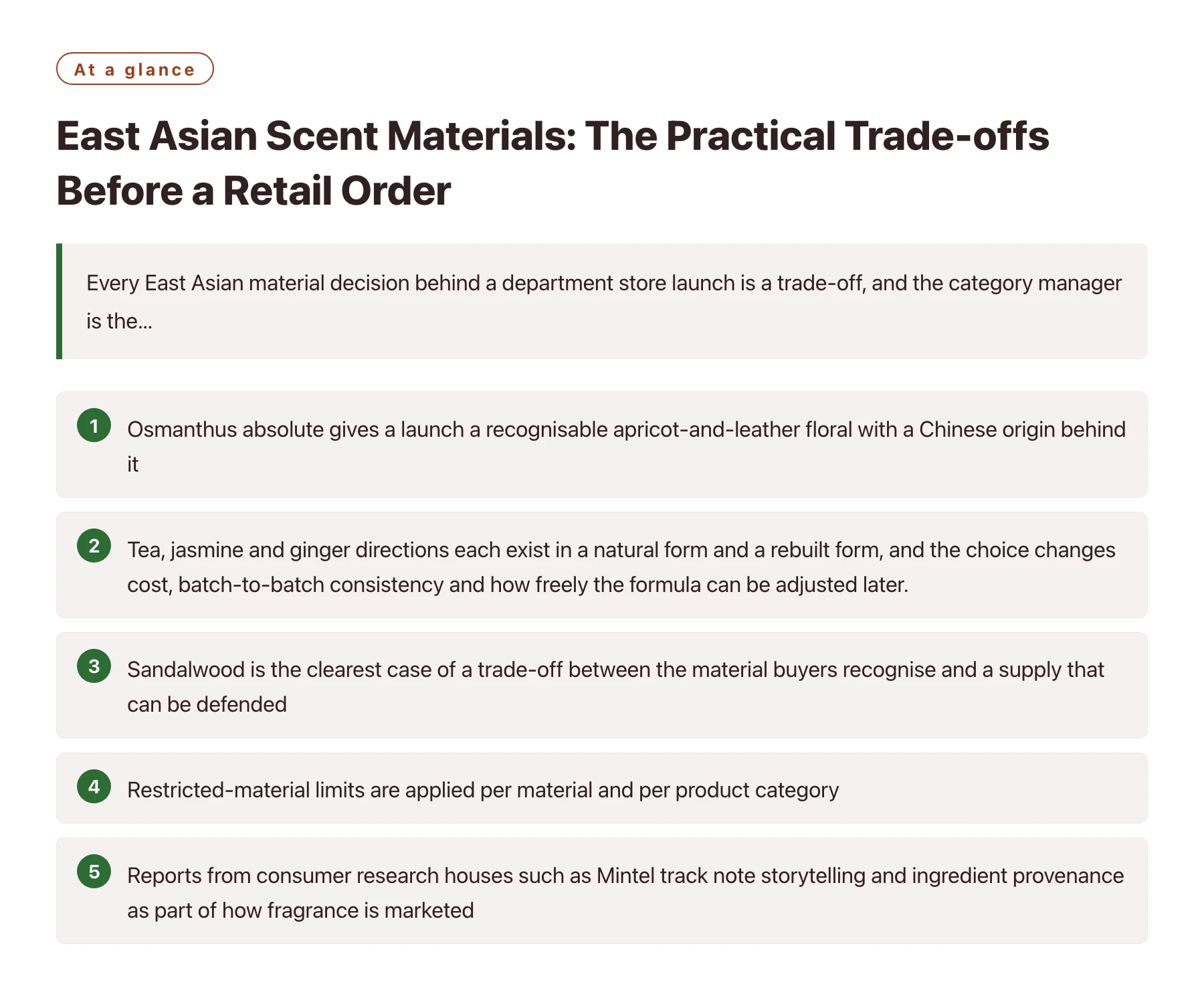
- Osmanthus absolute gives a launch a recognisable apricot-and-leather floral with a Chinese origin behind it, at a high material cost, with harvest variation and with a dose that is usually kept low because of price.
- Tea, jasmine and ginger directions each exist in a natural form and a rebuilt form, and the choice changes cost, batch-to-batch consistency and how freely the formula can be adjusted later.
- Sandalwood is the clearest case of a trade-off between the material buyers recognise and a supply that can be defended, because the creamy profile that holds a fragrance together is also the one that carries the most sourcing and restriction pressure.
- Restricted-material limits are applied per material and per product category, so a note that is comfortable in a fine fragrance can be constrained in a body product or a room spray [2].
- Reports from consumer research houses such as Mintel track note storytelling and ingredient provenance as part of how fragrance is marketed, which is why a category manager is often asked to justify a material choice rather than only a scent direction [1].
- The hardest trade-off to reverse is supply: a single-origin commitment can protect a signature note or leave a launch without a second source, depending entirely on how the commitment is written.
A department store launch raises the stakes on material choices because the product is judged next to established houses. On an open counter the fragrance is compared with scents that carry decades of brand equity, and the shopper can smell the difference before reading the price. That does not mean a new line has to buy the most expensive version of every note. It means the choices should be made with the retail setting in mind rather than in the abstract, and that the person defending the line needs to know which choices were made for smell, which for margin and which for supply.
East Asian materials are usually where this becomes concrete. Osmanthus, jasmine, tea, sandalwood and ginger all have a natural form and a rebuilt form, and each version shifts cost, consistency, regulatory headroom and the story that can be told on the shelf. A category manager who treats these as purely aesthetic questions tends to meet the cost and supply consequences after the order is placed, when the room to change anything has narrowed.
What follows is the trade-off set stated plainly, the two places where a department store launch makes these choices harder than a smaller channel would, and a way to decide without sampling every permutation of every note.
The trade-offs, stated plainly
| Decision | What you gain | What you give up |
|---|---|---|
| Real osmanthus absolute instead of a reconstruction | A recognisable apricot-and-leather floral with a provenance the counter staff can talk about | A high material cost, variation between harvests, and a formula that may need adjusting from lot to lot |
| A Chinese jasmine direction rather than a generic white floral | A softer, tea-adjacent floral that reads as East Asian rather than simply sweet | A narrower field of suppliers, and an indolic character that can turn sharp in some bases |
| A tea accord built on an extract rather than rebuilt from aroma materials | The slightly bitter, dry signature that makes a tea launch feel specific instead of generic | Weaker tenacity in soap and body products, and a shorter useful life in some formats |
| Sandalwood with a creamy, recognisable profile rather than a dry wood alternative | The fixation and skin warmth that hold a fragrance together for hours on the counter | Restriction and sourcing pressure that can force a reformulation in the middle of a launch |
| Fresh ginger oil for lift, against a dried-spice ginger accord for warmth | A bright, clean opening that separates the fragrance from heavier orientals in the same case | A short-lived top note and a sharper odour profile that some testers will dislike |
| A high natural load to support the story printed on the carton | A fuller, less linear scent and marketing language that matches what is actually in the bottle | Higher cost, more colour and stability risk, and less room to adjust the formula later |
| Committing to a single origin for the signature material | Consistent character and a supply relationship that is worth investing time in | Exposure if the harvest or the price moves, unless a second source is qualified in advance |
The point is not that naturals are better or worse than reconstructions. Each row is a decision with a visible cost, and the counter conversation changes depending on which ones were settled early and which were left open. A department store buyer will ask why the osmanthus is there and why the price is what it is, and that answer is much easier to give when the trade-off was chosen on purpose and the numbers behind it can be shown, which is also the discipline set out in where a perfume quote can hide costs.
What the retail setting adds to the decision
A department store launch changes the arithmetic in three specific ways, and none of them appear in a laboratory sample report.
Trade-offs that only appear at retail counter
The first is comparison. A fragrance sold online is judged mainly against its own description, while on a counter it is judged against whatever the shopper sprayed five minutes earlier. Real osmanthus or jasmine absolute tends to read as more distinct in that setting, whereas a very clean reconstruction can smell close to several neighbours and lose the comparison even when it is technically the better-made product. The second is tester behaviour: testers are sprayed heavily, left open and lit all day, so notes with weak tenacity or high colour can fade or shift in ways a controlled sample never shows. Both effects are matters of formula design as much as material choice, which is why the sequence from brief to bulk fine fragrance manufacturing matters when a launch is planned around a comparison it cannot control.
The third is the packaging interaction. A department store launch usually arrives with a heavier bottle, a cap, a carton and sometimes a gift set, and each of those adds variables to a formula that was chosen for its smell alone. A material sitting close to its use limit leaves little room to compensate for a base that behaves differently, so the trade-off is best tested against the actual pack rather than against a laboratory default.
How to decide without a round of samples for every option
Sampling every natural-versus-rebuilt pairing is the most expensive way to make this decision, and most of it can be resolved on paper. Start with the two or three notes the launch genuinely cannot do without, decide for each whether the natural version is audible at a realistic dose, and treat the rest of the formula as the place to recover cost. A note dosed at a fraction of a percent rarely justifies its natural price on smell alone, though it may still justify itself through the provenance printed on the carton.
Then put a number on each switch. If replacing a natural with a reconstruction saves a meaningful share of unit cost but loses a comparison that matters on the counter, that is a business decision rather than a perfumery one, and it belongs in the discussion with whoever owns the margin. Getting the terms of that decision written down early is the same discipline that applies to any supplier relationship, and it is what the checks that matter before signing a contract are for. It also prevents a material substitution from being presented later as a small technical adjustment rather than a change to what the customer was promised.
When the case has to be defended in one slide, put four lines on it: which notes are real, which are rebuilt, what each choice costs per unit, and what would have to change if a material became restricted or unavailable. Those four lines answer most of what a retail buyer or an internal finance lead will ask, and they make the choices look like decisions rather than omissions. A manufacturer that documents its development and manufacturing process makes the slide easier to build, because the cost and testing inputs can be checked against a description instead of reconstructed from memory. The process pages on the official site are a reasonable place to see how that is normally set out, and this is the kind of question a partner such as Xuelei, which states 31 years of fragrance manufacturing experience in Guangzhou, should be able to answer from prepared documents rather than from improvisation.
Sources
- Mintel Press Centre —— Mintel's press releases on consumer and beauty market research, including fragrance and personal care trend reporting.
- IFRA: Safe Use and Fragrance Science —— IFRA's explanation of how fragrance materials are scientifically assessed for safe use and how those conclusions are applied by the industry.
Frequently asked questions
Are natural East Asian materials always better for a department store launch?
No. Naturals such as osmanthus or jasmine absolute tend to give a recognisable character and a provenance story, which helps on an open counter, but they also bring cost, harvest variation and regulatory constraints. A rebuilt version can be the better commercial choice when the natural note sits low in the formula and the budget is better spent on the materials that dominate the first thirty seconds of the smell.
How much does a natural versus a reconstructed note change the unit cost?
It depends on the material, the dose and the volume, and the answer should come from a quotation that names the material rather than from a general rule. Ask for both versions costed inside the same formula so the difference can be read against the retail price, and remember that a note dosed at a fraction of a percent moves the unit cost far less than one that carries the opening.
What regulatory issues should be checked before choosing a note?
Restricted-material limits are set per material and per product category, so the same composition can be comfortable in one category and constrained in another. Confirm the intended product types and the markets where the line will be sold, and settle the position before a candidate is selected rather than after it has been costed and approved internally.
Should a first order commit to a single origin for a signature material?
A single origin can protect a distinctive character and build a supply relationship worth having, but it concentrates risk in one harvest and one price. The usual middle path is to qualify at least one approved alternative in advance, so any substitution is made with documented testing rather than under pressure in the middle of a launch.
How should material choices be explained to a retail buyer?
In terms the buyer can repeat to someone else: which notes are real, why they were chosen for this counter, what the price reflects and what would change if a material had to be replaced. Buyers generally respond better to a stated trade-off than to a claim that every choice was obvious from the start.
Have a story to shoot?
JC Altamirano Studio takes a small number of editorial and campaign commissions each season, shot personally from the Roma Norte studio.